


Why This Kolaveri..? Music Beyond All Bounds
Music can certainly not be bound by the barriers of language and geography. And it is once again proved with this Tamil song going viral over internet. In less than ten days of posting the song's buzzing with almost four million views...

Even the bollywood megastar Amitabh Bachchan tweeted: "Just heard #Kolaveri after much talk on it... it's so original and catchy... congrats Dhanush and Aishwarya (Rajni's daughter).. love".
This single released from the Tamil film ‘3’ by Tamil actor-singer Danush is fast emerging as the most shared video in India.
If literally translated “kolaveri di” means a burning or murderous rage in Tamil but in the song this very phrase has been used in a funny sense as a lover’s question to his girlfriend as to why he was dumped by her.
This song full of absurd lyrics, meaningless words and sung by an actor who sings as a hobby, has caught the attention of one and all. The credit to this can be given to the fact that even though the song may not make in-depth lyrical sense but it sure has a catchy tune and is extremely hummable. The signature line of the song itself must have been meaningless to non-Tamilians when it was initially released but it has transcended linguistic as well as spatial boundaries to become one of the most heard songs of recent times and that too in a very short span of time.
Music is fuel to soul, for sure!
Amazing India
India is amazing for sure and I am more than lucky as I get to see the mesmerizing corners of this wonderful nation. Thankyou God for letting me be born and alive on this land... Thankyou...
Hello! Hello! that doesn't mean that I am not willing to see the remaining world...
...Am still awaiting for that globe tour wish to be granted...
Amen :)

Hello! Hello! that doesn't mean that I am not willing to see the remaining world...
...Am still awaiting for that globe tour wish to be granted...
Amen :)


PUSHKAR: World’s Largest Cattle Fair


Every November, in the pond-sized sleepy town of Pushkar, India comes alive with a riot of colors and a frenzied burst of activity, attracting visitors from around the globe to the famous Camel Fair.
(The complete article was featured in Little India, a US publication...)
| ||
Renowned for hosting the world’s largest camel fair, the quiet town of Pushkar exhibits a rare and fascinating combination of religious fervor and cultural effervescence every November. Around 50,000 camels are sold, decorated, shaved and raced during the Pushkar Fair, the largest cattle fair in the world.
The ambience evoked during the seven-day festival is that of rustic Rajasthan, more so of rural India — vibrant, colorful and quintessentially Indian. Bards and poets recite and sing tales of valor and heroism of bygone days. Singers and dancers stage folk performances throughout the day. Various competitions, such as turban tying, tilak, water pot race, mandna, langari taang, Indian bride, moustache, and wrestling, etc., enliven the event. “I like the turban tying and tilak competition. They are so Indian,” said Daniel Schwenegger, a tourist from Denmark. In addition, many animal competitions, such as camel decoration, camel dance, horse dance, fast milking, gir and cross-breed and champion cattle contests delight visitors. “The lumbering beast of burden, the camel all decorated in finery, imagines itself to be an ostrich, and rushes through the race like one. It’s such fun. I have never seen anything like this before,” said Australian college student, Diana Wheat. (To read the complete article, visit the site of Little India, a US publication...)    |
Reverse Take
|

BEING CRAFTY!
By Shilpi Shukla Alexander
(This article was published in The Hindu newspaper
 |
| Photo: Lovejeet Alexander |
Handicrafts Cluster Creations at Dilli Haat brought in the best that the States could offer...
The Handicrafts Cluster Creations 2011 that was on at the Dill Haat till recently saw avid shoppers thronging the place even during weekdays. Welcoming the fresh hues of spring, the handicrafts exhibition-cum-sale allowed visitors to indulge in a world of traditionally rich and awe-inspiring craftsmanship. With an exquisite range of metal, brass, wood and bamboo handicrafts to those in iron, marble and clay, the fair had something for everyone.
The stalls from the North-east came laden with exciting bamboo and cane craft pieces.
Handloom rugs, carpets, floor mats and durries came were made to floor anyone! “I bought two Kashmiri carpets richly adorned with traditional chain-stitch embroidery. The collection in the fair was really exciting this time,” said Ritu Malik, a teacher.
Zardozi and jamdani silk from Benaras, kantha silk from West Bengal, chanderi and tussar ghicha silk from Madhya Pradesh, cotton handloom from Uttar Pradesh, pashminas from Kashmir and the many silks from the South were a delight for the textile connoisseurs. For those interested in rich traditional work, there was kalamkari work and crochet embroidery from Andhra Pradesh, crewel embroidery and patchwork from Jammu and Kashmir, and kinnari work from Himachal Pradesh, among many others. “I particularly loved the Kashmiri crewel embroidery and kinnauri shawls from Himachal Pradesh,” said Su Li, a tourist from China. Decorations for home ranged from beautiful terracotta to wicker work, papier-mâché bowls to wooden trays, and lac items to kolhapuris.
While the regal touch came with marble artefacts, miniature sandalwood and silver items, reasonably-priced pottery and ceramic work from Maharashtra was surely not worth a miss. Foreign tourists seemed particularly fascinated. According to Marc Jacobs from Canada, “The marble artefacts from Agra and these beautiful miniature paintings from Rajasthan exhibit marvellous workmanship, which is the USP of India indeed.”
Other attractions were the gems and jewellery at the Rajasthani counter. Also, bead necklaces and footwear of Nagaur, textiles printed in Ajmer and Jodhpur, brassware of Jodhpur and Jaipur and colourful puppets.
For those who had their fill of shopping, the exhibition featured interesting cultural shows, live performances, food from the states, and interesting competitions.
HINDI: Lost in the homeland?
Ashok Chakradhar talks to Lovejeet Alexander about promoting Hindi that people speak in their everyday life...

They become stars overnight by delivering impressive dialogues in Hindi films and then these actors of Hindi cine-industry shy away from giving interviews in Hindi. Hindi probably doesn't match their class. Hardly are any celebrities heard speaking in Hindi. For most youngsters, (and now even toddlers in our metros), the usage of spoken Hindi is considered behind the times. When did Hindi become a language of the old-fashioned and semi-literate? When did we start disgracing our national language?
In a candid interview, eminent Hindi poet, writer, anchor and activist Ashok Chakradhar highlights people's apathy towards our national language and offers practical solutions towards saving Hindi.
In fact, even before you ask him about the state of Hindi, Chakradhar, the vice president of the Hindi Academy, speaks his mind, “I accept that Hindi is losing its prominence and popularity among the young generation. It is said that in 20-25 years from now, Hindi will become the language of rickshaw pullers and vegetable sellers and the like. Still, Hindi has the power to sustain and also spread and ‘truly' become the language of every Indian. All it needs is some serious conscientious thinking and planning by one and all, especially by the Government, linguists and Hindi departments of our universities towards making it a common man's language.”
Sanskrit-laden
Not that English has gained popularity in recent years. Chakradhar says, “We have always had ardent English speakers. Most of them having been educated abroad, even our well-read freedom fighters used to converse in English amidst themselves.” Soon after the British left India, efforts were made to help Hindi gain back its stature in the nation.
However, the immediate steps were not so effective. “The idea was to make Hindi the official language by the year 1961. For this purpose, a relaxation period of 10 years was granted by the Constitution during which all the Government departments and Ministries had to start using Hindi for all correspondence. However, the kind of Hindi language used officially was too Sanskrit-laden and literary and hence, too unlike that of the common man's.” This way, the steps taken to promote and popularise Hindi proved fatal as it led to citizens preferring simple English to archaic Hindi.
A witness to the gradual decline in the popularity of Hindi since Independence, Chakradhar says the times of classical Hindi are far from tover for the masses. An ardent promoter of modern Hindi, he adds, “If they truly intend to promote our national language, it is time the Government, linguists and Hindi organisations switched over to Hindustani, the simpler version.” Citing the perfect example, the poet says, “The only department that has adopted the easy-to-follow version of Hindi language is the Railways. Railway platforms, junctions, stations, coolies etc, are all English words that have now been adopted as part of Indian Railways' Hindi vocabulary. Other departments should follow suit.”
Hindi for net
Technological advancements must also be made for recording and preserving languages. For example, Unicode should be used for documenting languages other than English. “We should also have Hindi social networking sites,” proposes the well-known writer.
The great Hindi lover is quite saddened that there are not many promoters of Hindi language. “Promoting regional languages is never a problem for we always have respective masses willing to work for the cause. Unfortunately, when it comes to Hindi, those willing to advocate this rich language are really few. This is a major hold-up in this case.” The strong-willed man soon regains his composure and focus to add, “We maybe few in number but our love for the cause of reviving our mother tongue is undying.”
So long as we have people like Ashok Chakradhar, there lives a hope for Hindustani becoming the language of every Hindustani as Mandarin is for every Chinese and Japanese (the language) is for Japanese.


Indian Classical Music: Medicine in melody
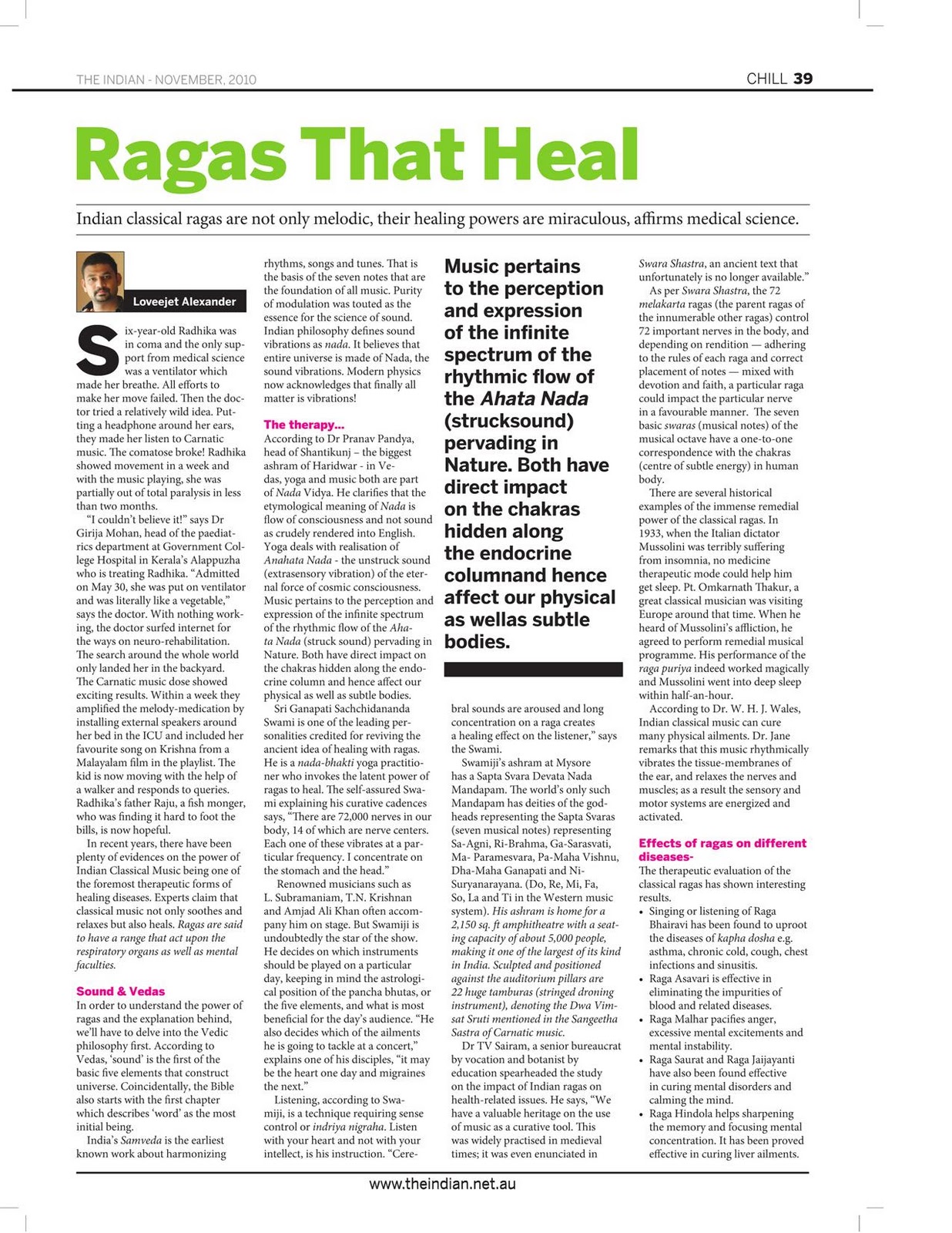
The Healing Ragas
READ THE COMPLETE STORY
The story published in the December 2010 issue of THE INDIAN - a monthly tabloid - published from Australia catering to the tastes of an ever-changing Australian-Indian diaspora.
CELEBRATING JUGAAD

The Commonwealth Games were a triumph of Indian Jugaad
India may be staking a claim as a global economic superpower, butjugaad remains an Indian obsession. And it was on glaring public display at the Commonwealth Games in the nation’s capital in October...
CLICK HERE for the complete story
Cover Story for the magazine - Little India - the largest circulated Indian publication in the United States, as well as the largest circulated overseas Indian publication in the world.
TWIN CAPITAL OF THE WORLD
| CLICK HERE for the complete story | |||||||||
|


Vrooming in India too!

It’s official. India for the first time in history will be hosting Formula One Grand Prix. Only condition is that the track needs to be ready by July 30 and achieves an FIA homologation. Lovejeet Alexander visits the tracks for The Indian to find the turns and bumps hidden in each lap of the circuit projected to be one of the fastest and most entertaining of any other all across the globe.
The high-tech city of Greater Noida, situated around thirty kilometres from New Delhi has been known to the world for giving the best of the racing video games. What seems to be inspired from the gaming outsourcer’s virtual design, Jaypee Group is constructing a real motor racing track in the city. Stature of the project could be judged by the mere fact that recently, following an extraordinary meeting of the World Motor Sport Council in Paris, the calendar announcement for GP 2011 included the venue too. Addition of the Indian GP to F1 calendar will make 2011 a 20-race season, longest in the history of the sport.
NETAGIRI IN AMERICA

So goes a popular saying. In the Indo-American community, which is blessed with political gyan and rational aptitude, political ambitions are bound to sprout. After successfully capturing crucial administrative seats in the White House, Indo-Americans now set their targets higher. Keep reading for an insight on the increasing number of Indians jumping into the American political arena.
A couple of years ago, former British Conservative Party deputy chairman Lord Archer, while on tour promoting his novel A Prisoner Of Birth, made some very unusual comments. He said, “Britain is going to be taken over by Indians. And I don’t joke. Indians are taking over the local councils. There are mayors all over England who are Indian.” Pointing to a young journalist he said, “You are young enough, I suspect, to live to see an Indian prime minister in England.”
Although his prediction may look more like a satire, the prophecy rightly catches the trend on track. Migrant Indians, after taking over boardroom seats, are now aiming for political thrones. Which other nation could offer a better land to set that example, if not America? The United States has always been a fertile land for Indian talent to breed. The ambitious Indian community in the US has started trying its luck in the government with full vigor.


Cover story for the American magazine DeshVidesh (September 2010). Desh-Videsh magazine, is widely circulated in the southeast US. Readers hail from Florida, Georgia, Washington, DC, Maryland, Virginia, North Carolina and South Carolina. The magazine reaches a varied audience of over 50,000 Indians, Pakistanis, Bangladeshi, and Indo-Caribbeans.
I Heard The Crows Call For Rain
As scientific tools falter in predicting rain patterns, Indian scientists turn to the Vedas and traditional knowledge for some fine tuning.
Nearly 70 percent of India’s population relies almost exclusively on agriculture, so accurate weather forecasts are extraordinarily important. During the past 100 years, the monsoon has been normal 85 times, so predicting an uneventful season is relatively safe. Nevertheless, during the last two decades, the official rainbow chasers have gone terribly awry.
Retired Air Vice Marshal Ajit Tyagi, director general of Indian Meteorology Department (IMD), admits, “The extremes are really difficult to forecast.” The 135-year-old department, supported by dedicated satellites and hordes of sophisticated Doppler radars, predict the amount of rainfall (in percentage) annually. Every year, IMD projects precipitation levels on a scale, in which it predicts either a normal monsoon, a drought or a flood. The country’s economic fortunes and rural lives hang on its projections.
 |
Published in the magazine - Little India - the largest circulated Indian publication in the United States, as well as the largest circulated overseas Indian publication in the world.
Hari's flute, Krishna's tune

Music was not a genetic bequest for Pandit Hariprasad Chaurasia. His father, a wrestler of international repute, wanted him to enter the world of muscle combat. But his interest lay in the much softer and mellower notes of life.
At the age of 15, Chaurasia embraced music for life. When asked how difficult it was to switch from the game of muscle to the play of chords, he says, “It was difficult, but at the same time, fascinating too.”
At the age of 15, Chaurasia embraced music for life. When asked how difficult it was to switch from the game of muscle to the play of chords, he says, “It was difficult, but at the same time, fascinating too.”
Panditji began learning classical vocal from Pandit Raja Ram of Benares. The journey had just begun. His destination still looked hazy and distant. It was after attending a flute recital by Pandit Bholanath that the foundation for a flute legend was laid. Call it love at first sight or at first sound, the flute became his soul, his essence of life. His flute knows the delightful art of conveying delicate levels of feelings through subtle manipulation of tones and intervals.
Avoiding all pinpoints he says, “I treat my each concert like first and last, so each one of them is memorable to me.” For audiences, this is definitely the case. “Music is my prayer and each auditorium a temple,” he adds. Pandit Chaurasia is a musician who is credited for developing a style that is respectful of tradition, yet full of novelty. Touching the chords of every heart, even his critics remain in awe of his style.
Avoiding all pinpoints he says, “I treat my each concert like first and last, so each one of them is memorable to me.” For audiences, this is definitely the case. “Music is my prayer and each auditorium a temple,” he adds. Pandit Chaurasia is a musician who is credited for developing a style that is respectful of tradition, yet full of novelty. Touching the chords of every heart, even his critics remain in awe of his style.


Cover story for the American magazine DeshVidesh (August 2010). Desh-Videsh magazine, is widely circulated in the southeast US. Readers hail from Florida, Georgia, Washington, DC, Maryland, Virginia, North Carolina and South Carolina. The magazine reaches a varied audience of over 50,000 Indians, Pakistanis, Bangladeshi, and Indo-Caribbeans.
Subscribe to:
Posts (Atom)